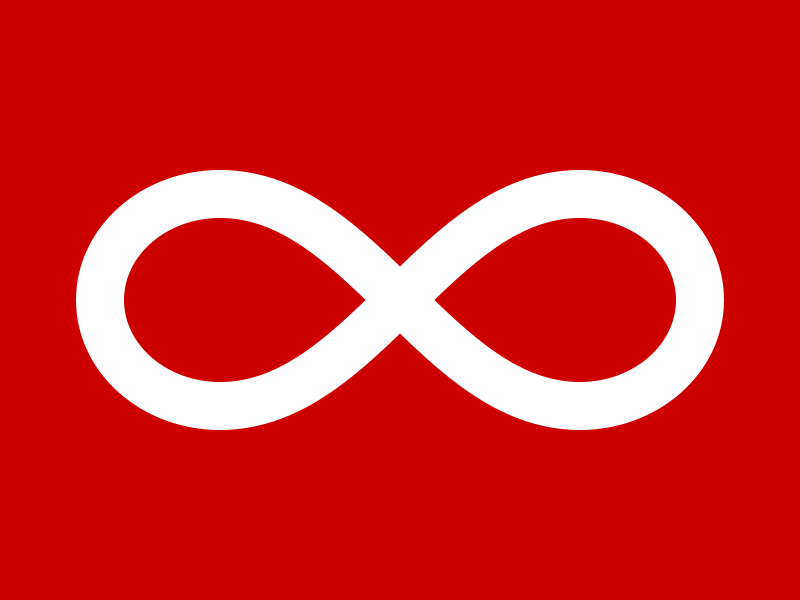
The Métis infinity flag is the oldest patriotic flag native to Canada, predating the national Maple Leaf by over 150 years. Yet, for many descendants, a persistent question remains: What do the colours red and blue really mean? For families with roots in the “Country-born” (English/Scottish-Cree) tradition and high-ranking Hudson’s Bay Company (HBC) ancestors—such as James Curtis Bird and Thomas Thomas—the answer is tied to both corporate politics and our national identity.
The Origins of the Infinity Symbol
The horizontal figure-eight first appeared in the historical record around 1814. Contrary to the myth that it was a “gift” from the North West Company (NWC) to “manipulate” the Métis, modern scholars and oral tradition suggest we adopted the symbol ourselves to assert our sovereignty as a “New Nation.”⁷, ⁹ The symbol represents the joining of two cultures (European and Indigenous) and the immortality of our nation.⁵
Red vs. Blue: Corporate Loyalty or Cultural Divide?
The existence of both red and blue variants has sparked significant debate. The most historically verified distinctions are:
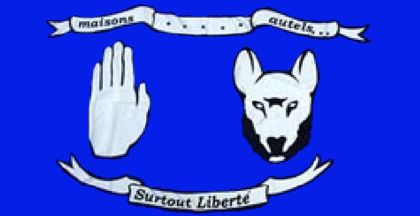
- The Blue Flag: This version was presented to Cuthbert Grant by NWC partner Alexander Macdonnell in 1814.⁴ It became the banner of the French-speaking, Catholic Métis (often called Bois-Brûlés) who were aligned with the NWC during the fur trade wars.
- The Red Flag: This variant is historically linked to the Hudson’s Bay Company (HBC).¹ Evidence suggests that Métis groups with English, Scottish, or Orkney ancestry (the “Country-born” or Half-breeds) favoured the red background.³, ⁶

Ancestral Spotlight: Bird and Thomas at Red River
Our ancestors, James Curtis Bird and Thomas Thomas, represent the upper echelon of the Red River Settlement’s social and political structure. As Chief Factors for the Hudson’s Bay Company, they were the architects of the colony’s administration.
- The HBC Red Ensign: In a professional capacity, Bird and Thomas would have primarily operated under the HBC Red Ensign—a British flag with “H.B.C.” in the fly.⁷
- The Family Flag: Given our heritage and their deep HBC ties, if their households or relatives displayed a Métis symbol, the red infinity flag would be the accurate historical choice to match our ancestors’ corporate and cultural world.
Variants at the Red River Resistance (1869–1870)
A common concern for modern Métis is whether one group felt “left out” if their colour wasn’t flown. History suggests our people in the 1800s were much more comfortable with symbol diversity. During the Resistance, several flags flew:
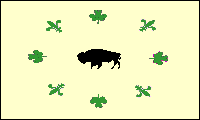
- The Provisional Government Flag: Louis Riel’s government often used a white flag featuring fleurs-de-lis (French roots) and shamrocks (Irish-Catholic alliance).
- The Buffalo Hunt Flags: Different hunting brigades often had our own unique banners. Some used the infinity symbol, while others used religious icons or simple coloured cloths depending on who provided the fabric.²
- The Union Jack: Paradoxically, many English-speaking Métis often flew the Union Jack to signal that our demands for rights were being made as British subjects.
Debunking the Myths: Tribalism vs. Practicality
There are two common myths that often confuse our history:
- The “War vs. Peace” Myth: Some believe red was for war and blue for peace. There is no contemporary historical evidence to support this; it is a later romanticization.⁹
- The “Tribalism” Myth: The idea that there was “offense” taken over the colours is largely a modern projection. In the 19th century, the symbol (the infinity loop) was the unifying “brand.” The background colour was often determined by whatever cloth was available at the local trading post or which company the brigade was currently freighting for.⁸
Modern Perspective: Two Sides of One Coin
It is worth noting that in 2026, modern Métis scholarship has moved even further away from the “one or the other” mentality regarding our flags. Recent community dialogues emphasize that the red and blue flags are now seen as two sides of the same coin—representing a nation that was never monolithic but always unified by the infinity symbol.
This perspective provides a “bridge” from the historical conflicts of the 1800s to our current era, showing that our Métis identity is still evolving and inclusive. Instead of viewing the red and blue as competing factions, they are now widely seen as a reflection of a nation with many voices—English-speaking, French-speaking, Catholic, and Protestant—all unified by the same heartbeat.⁵, ⁸
Conclusion
For the descendants of James Curtis Bird and Thomas Thomas, the story of the flag is a story of balance. Our ancestors navigated the complex world of the HBC, yet they were part of a cultural landscape that was uniquely and fiercely Métis. Whether the flag flying was red or blue, it stood for a people who could not be divided by a simple choice of fabric. In the 1800s, we were a “polyphonic” nation—many voices, many colours, but one shared identity.
Sources
- Eastern Woodland Métis Nation, “The Métis Flag (History).”
- Vexillology Wiki, “The Flags of the Métis.”
- Rocky Mountain Métis, “Metis Culture & History.”
- Kiddle Encyclopedia, “Métis flag Facts for Kids.”
- Windspeaker News, “One Flag, Two Flags, Red Flag, Blue,” July 29, 2020.
- FlagMart Canada, “Buy Red Métis Flag Online.”
- Canada Ehx, “The Indigenous And The Hudson’s Bay Company,” December 26, 2020.
- Gabriel Dumont Institute, “The Métis Flag.”
- Métis Nation of Alberta, “The flag of the Métis.”
- Historical Flags: Metis Nation (Canada), flag variant images
 tilixam
Leave a comment