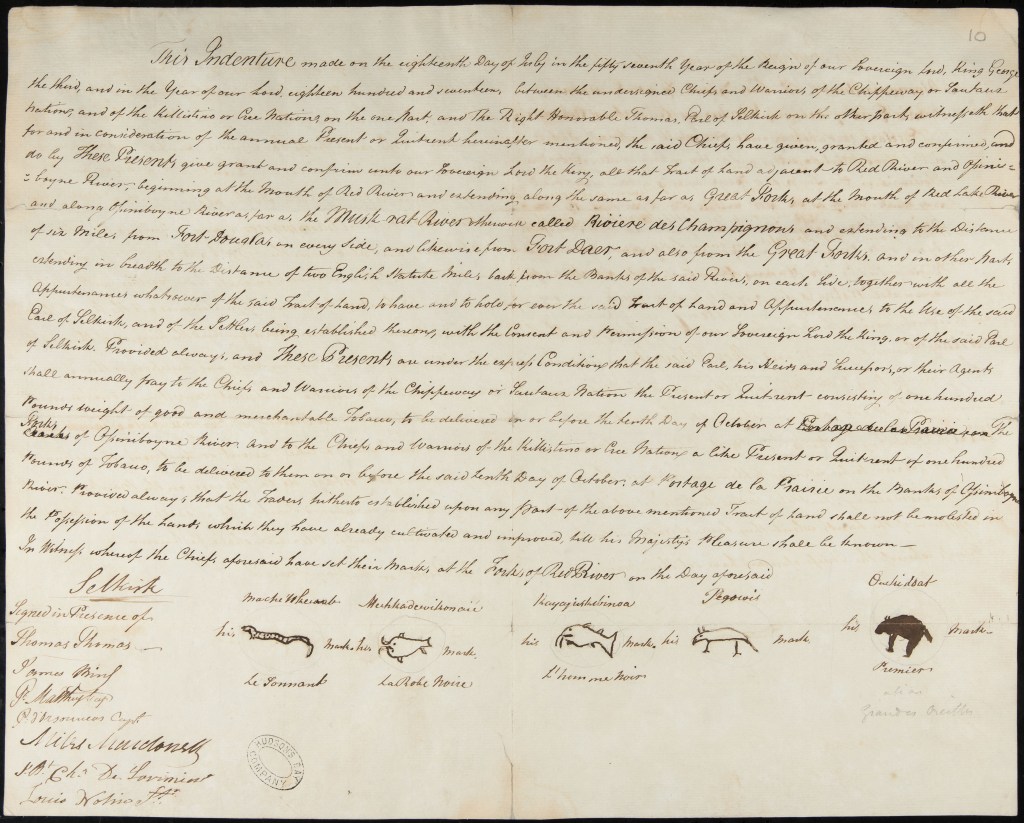
In the history of the Canadian West, treaties are often presented as dry legal documents signed between strangers. But if you look at the 1817 Selkirk Treaty through the lens of the Bird family, a different story emerges: one of calculated kinship and a father who ensured his family was “covered” no matter which way the political wind blew.
The Architect: James Curtis Bird
By 1817, James Curtis Bird (my 4th great-grandfather) was one of the most senior officials in the Hudson’s Bay Company. Following the death of the previous governor at the Battle of Seven Oaks, Bird was appointed Acting Governor of Rupert’s Land.¹ It was in this capacity that he stood as a primary witness to the Selkirk Treaty on July 18, 1817. To ensure the treaty’s success, Bird didn’t just rely on Company authority; he relied on his family’s unique connections.²
The Strategic Bridge: Jemmy Jock and Chief Peguis
The most strategic “placement” in the Bird family was James “Jemmy Jock” Bird. While his father witnessed the treaty with Chief Peguis, Jemmy Jock was already deeply connected to Peguis’s people through his marriage to the Chief’s daughter, Elizabeth Prince.³
This kinship was a powerful diplomatic asset:
- Trust: In Indigenous diplomacy, treaties were often based on family bonds. Having a son married into Peguis’s family gave James Curtis Bird a level of trust and access that other HBC officials lacked.⁴
- Intermediaries: It positioned the Birds as the essential bridge between the Indigenous leaders of the plains and the emerging Red River Colony.⁵
Hedging the Bet: The Colony vs. The Country
James Curtis Bird ensured his family had a stake in both the “new” settled world and the “old” fur-trade world:
- In the Colony: He kept sons like George Bird (my 3rd great-grandfather) in the Red River area. George became a settled farmer on the very lands secured by the treaty, maintaining the family’s status in the St. Andrews Parish elite.⁶
- In the Interior: He supported Jemmy Jock’s transition to the Western plains. Jemmy Jock eventually became a legendary figure among the Blackfoot Confederacy, ensuring the Bird name carried influence far beyond the reach of the colony.⁷
The 15x Bonus: Comparing the “Price” of Diplomacy
The value of this influence is reflected in the land grants. My other 4th great-grandfather, Thomas Thomas, was also a high-ranking official and a treaty witness.⁸ However, while Thomas received a standard retirement lot, James Curtis Bird was eventually granted a massive 3,000-acre estate.⁹
To put that in perspective, a standard river lot for a retired officer was approximately 200 acres.
James Curtis Bird’s grant was roughly 15 times larger than the average lot. This made him one of the largest private landowners in the history of the Red River Settlement.¹⁰
Conclusion: A Legacy Carved in Land
This disparity highlights how much the HBC valued the “family diplomacy” the Birds provided. James Curtis Bird didn’t just witness a document; he helped navigate a partnership that allowed the settlement to survive. Today, Birds Hill Provincial Park stands on his original property—a permanent reminder of a family that sat at the crossroads of Western history.
Endnotes
- John E. Foster, “Bird, James (James Curtis),” in Dictionary of Canadian Biography, vol. 8 (University of Toronto/Université Laval, 1985), www.biographi.ca.
- “Document – Lord Selkirk’s Treaty with the Indians, July 18, 1817,” Manitoba Historical Society, www.mhs.mb.ca.
- “James ‘Jimmy Jock’ Bird (1798–1892),” Red River Ancestry, www.redriverancestry.ca.
- John C. Jackson, Jemmy Jock Bird: Marginal Man on the Blackfoot Frontier (Calgary: University of Calgary Press, 2003).
- “James ‘Jemmy Jock’ Bird (ca. 1798-1892),” Metis Museum, www.metismuseum.ca.
- “James Curtis Bird (1773–1856),” Red River Ancestry, www.redriverancestry.ca.
- Jennifer S.H. Brown, “James Bird Jr.,” The Canadian Encyclopedia, thecanadianencyclopedia.ca.
- “Thomas Thomas (c.1766–1828),” Memorable Manitobans, Manitoba Historical Society, www.mhs.mb.ca.
- “Birds Hill,” Red River North Heritage, redrivernorthheritage.com.
- ¹”James Curtis Bird Sr. (abt.1773–1856),” WikiTree, www.wikitree.com.
More information on Birds Hill:
 tilixam
Leave a comment