A homesteading experience of the Canadian west from a Norwegian (Immigrant) perspective.
Introduction
As Canadians, we often hear about “free land” and the early settlers who built this country. But when we look into our own family trees, these abstract historical events transform into deeply personal stories of risk, resilience, and the relentless search for a better life. This is the story of my great-grandparents, Adolph and Ingeborg Brager, Norwegian immigrants who chased a dream from North Dakota to the untamed prairies of Alberta and, finally, Saskatchewan. Their journey didn’t end with them; it continued through their sons, Arthur and Ingvald, also took up the mantle of homesteading to help secure their family’s future on the Canadian prairie.
Part 1: Chasing the Dream – Homestead Entry
The story begins in the late 19th century when Adolph and Ingeborg left their native Norway. They didn’t travel together; instead, they arrived in the United States at different times with their respective families. They eventually converged in Mayville, North Dakota, where they met and were married.
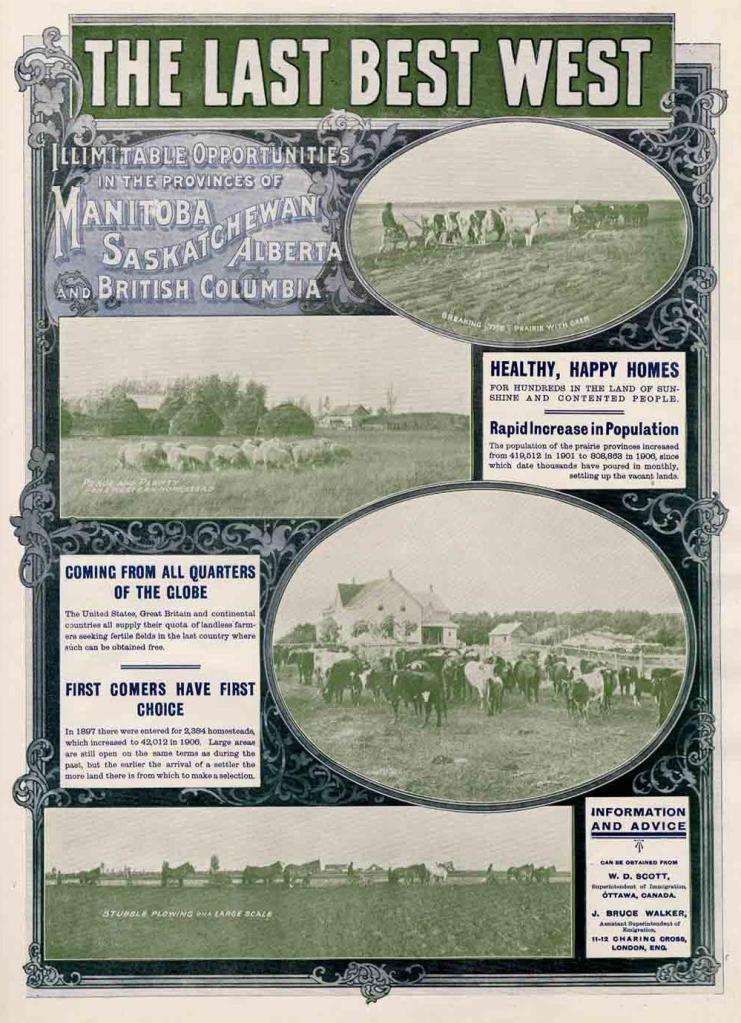
While they had established a life in North Dakota, the promise of “free land” further north became a powerful pull. In the late 1890s, the Canadian government launched a massive campaign to settle the “Last Best West.” Pamphlets translated into Norwegian promised 160 acres of land for a mere $10 entry fee. For a young family in North Dakota, where land was becoming scarce and expensive, it was a siren song too loud to ignore. In 1900, the Bragers pulled up stakes, crossed the border, and headed for Star, Alberta¹, near present-day Lamont. This was one of the earliest Scandinavian settlements in the province, offering familiarity and a cultural connection.
The “Failed” First Claim
This is where the true reality of homesteading set in. When our family history notes that “they didn’t like it,” they were not alone. The Canadian prairie was a lottery. While the land might be free, its quality was a complete gamble. Homesteaders in Star, Alberta, often faced daunting challenges; the land could be heavily “bushed” or have poor soil that was too marshy to fulfill the strict “proving up” requirements.
It was during this difficult period of uncertainty that my grandfather, Ingvald Brager, was born in Star, Alberta, in 1902. He was a child of this struggle, born just as his parents realized that a future on this specific plot was impossible. They chose to abandon their Alberta claim—legally clearing their record—to try one more time.
Part 2: A Fresh Start – Birch Hills, Saskatchewan (1903)
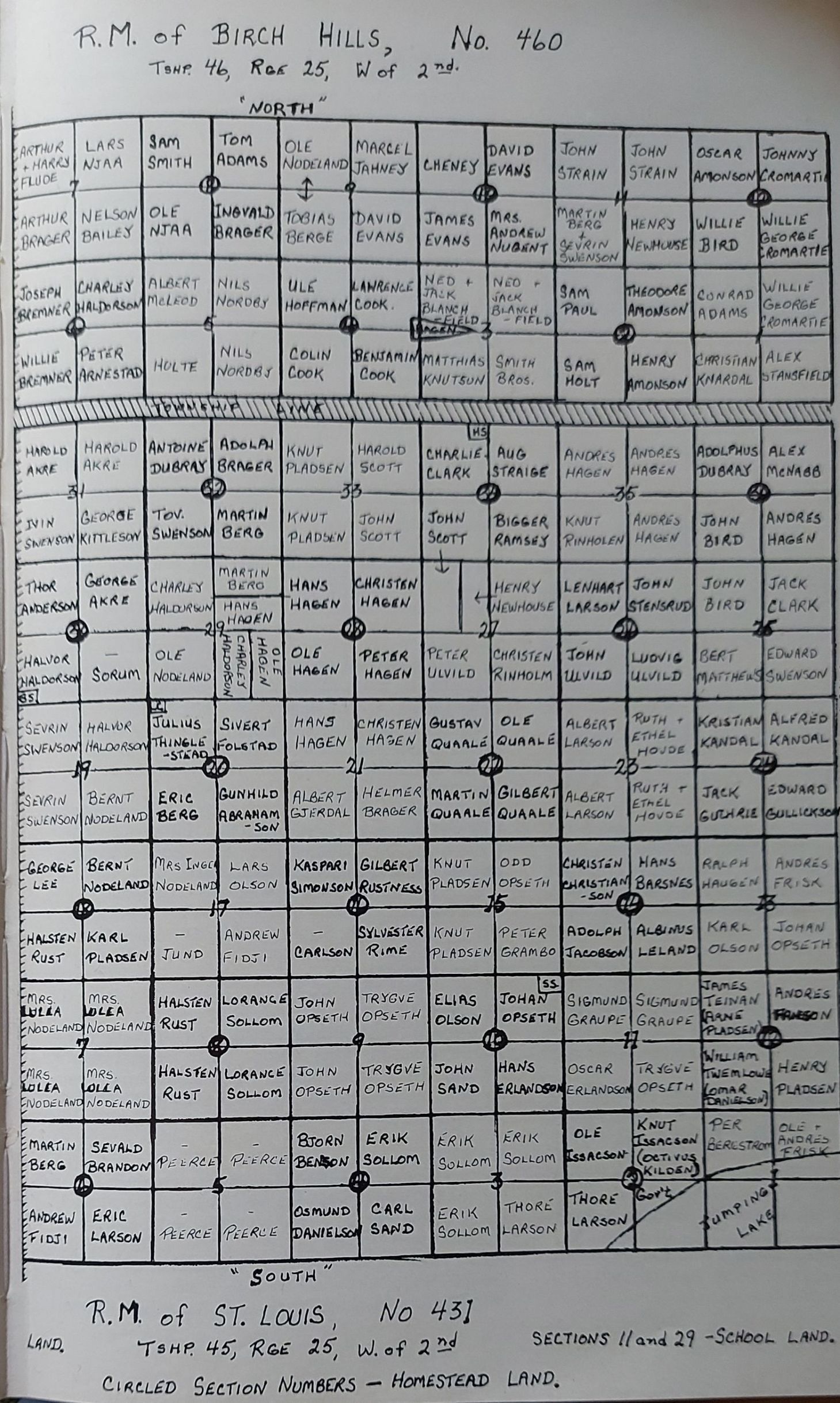
In 1903, the Brager family packed up their lives and trekked east. They were following the path of thousands of other Scandinavian-American settlers seeking richer soil and better opportunities. They found it in the Birch Hills region of Saskatchewan. Here, in what would become the R.M. of St. Louis No. 431, Adolph finally found the land he was looking for: NE-32-45-25-W2².
Part 3: What It Meant to “Prove Up”
To get the official Patent (the actual ownership title) for their 160 acres, Adolph and Ingeborg had to work harder than they ever had before, fulfilling strict requirements within three years³:
- The Homestead Entry: Adolph paid his $10 fee to officially file his claim.
- Six Months of Residence: They were required to live on their homestead for at least six months a year for three continuous years⁴.
- A “Habitable House”: Building their home was the first priority. It wasn’t a beautiful farmhouse; it was a small, dark log cabin or soddy that offered little protection against the elements.
- Continuous Cultivation: Breaking the tough, ancient prairie sod required a heavy “breaking plow” and strong horses. They were required to break and crop a minimum number of acres each year.
- Fencing and Improvements: This included building a stable and digging a well—all recorded by a visiting Homestead Inspector before the Patent was granted⁵.
Part 4: The Next Brager Generation – Expanding the Footprint
As Adolph’s sons reached adulthood, the family’s strategy became clear: they were using the homestead system to secure a significant footprint in the Saskatchewan prairie. By the early 1920s, the Brager men held land across four different sections.
While their quarter-sections were not all physically adjacent, the Bragers created a powerful family cluster within the Hagen district. By securing land across Sections 7, 8, 21, and 32, they ensured the family remained within a few miles of one another—close enough to share labor and heavy machinery, yet spread out enough to claim different pockets of the local soil. This “district cluster” allowed the family to maintain a strong social and economic presence in the community while each son worked to “prove up” his own individual claim.
- Helmer Brager secured SE-21-45-25-W2¹¹.
- Ingvald Brager secured SE-8-46-25-W2⁹.
- Arthur Brager secured SW-7-46-25-W2⁷.
Whether through a standard $10 entry like Helmer and Ingvald, or a Soldier Grant like Arthur, the Bragers successfully converted their collective family labor into a significant holding of prairie real estate.
Part 5: The Soldier’s Grant – Arthur Brager
Arthur Brager, my great uncle, accessed his acreage through a different government program called the Soldier Settlement Act. After serving in World War I⁶, Arthur was eligible for a Soldier Grant at SW-7-46-25-W2⁷.
- The Grant: Unlike a standard homestead, the Soldier Grant was a direct reward for service.
- Financial Assistance: Arthur had access to the Soldier Settlement Board (SSB). This board provided low-interest loans—often up to $7,500—specifically for the purchase of livestock, farm implements, and the erection of buildings⁸.
Part 6: The Standard Entry – Helmer & Ingvald Brager
While Arthur utilized his veteran status, his brothers Helmer and Ingvald followed the traditional path laid out by the Dominion Lands Act. Once Helmer and Ingvald were of age to apply for their lands in Saskatchewan also they did so, following in their fathers footsteps.
Helmer Brager filed for SE-21-45-25-W2¹¹, positioned in the same district as the family anchor plot. My grandfather, Ingvald Brager, followed the exact same “Free Land” rules his father and eldest brother did, and he filed for his own land at SE-8-46-25-W2 once he came of age⁹.
To secure their Patents, both brothers had to adhere to the same rigid requirements:
- The Entry: Filing the application and paying the $10 administrative fee.
- The Six-Month Rule: They were legally required to live on their specific quarter-section for at least six months of the year for three consecutive years.
- The Breaking: They had to provide proof of “breaking” the soil—turning the raw prairie into tillable crop land.
- The Final Patent: Only after a government inspector confirmed their improvements did they receive the Patent (the deed), giving them full ownership of the 160 acres¹⁰.
Summary of the Brager Land Holdings Discussed
| Family Member | Legal Description | System Used | Method |
|---|---|---|---|
| Adolph | NE-32-45-25-W2 | Homestead: Dominion Lands Act (1872) | Homestead Entry |
| Helmer | SE-21-45-25-W2 | Homestead: Dominion Lands Act (1872) | Standard Entry |
| Arthur | SW-7-46-25-W2 | Soldier Grant: Soldier Settlement Act (1919) | Soldier Grant |
| Ingvald | SE-8-46-25-W2 | Homestead: Dominion Lands Act (1872) | Standard Entry |
Conclusion: A Legacy of Hard Work
Adolph and Ingeborg successfully “proved up” their land, turning wild prairie into a titled asset through sheer grit. However, their stay in Saskatchewan was not a permanent one. Life on the prairies was complex; environmental hardships, economic volatility, and the physical toll of farming eventually led the family to look toward the coast.
When Ingvald and Arthur eventually moved their families to New Westminster, BC, they did so with the power of legal equity. Because the homestead system had granted them clear, recognized titles to their land, they had the agency to leverage their hard-won assets to seek a new life.
But as I look at the other side of my family tree, the story changes. While my Norwegian grandfather was being “given” land for a $10 fee, my Métis grandmother’s family was being forced to “buy” back a seat at the table using Scrip—a system designed to take more than it ever gave.
The Great Prairie Lottery (Pt 2): The Métis Comparison, coming very soon!
ENDNOTES
- Initial arrival and abandonment in Star, Alberta (Appendix A, item A1).
- Successful 1903 entry in Hagen/Birch Hills (Appendix A, item A2).
- Dominion Lands Act “Proving Up” requirements (Appendix D, item D1).
- Residence and residency requirements (Appendix D, item D2).
- Final Patent issuance for Adolph Brager (Appendix B, item B1).
- Arthur’s WWI service and Soldier Grant eligibility (Appendix B, item B2).
- Arthur Brager’s land coordinates (Appendix A, item A4).
- Soldier Settlement Board (SSB) loan and administrative role (Appendix D, item D3).
- Ingvald Brager’s birth in Star, Alberta, 1902 (Appendix B, item B3).
- Final Patent issuance for Ingvald Brager (Appendix B, item B4).
- Helmer Brager’s homestead entry at SE-21-45-25-W2 (Appendix A, item A5).
APPENDIX A — GEOGRAPHIC & MOVEMENT ANCHORS
A1. Star, Alberta (1900
Adolph Brager’s first entry point in Canada; the family abandoned the claim in 1903. Primary; Alberta Homestead Index.
A2. NE-32-45-25-W2 (Adolph)
Successful homestead in the R.M. of St. Louis (Hagen/Birch Hills area). Primary; Saskatchewan Homestead Index; Reflections on the Past.
A3. SE-8-46-25-W2 (Ingvald)
Homestead claim of Adolph’s son, located in the R.M. of Birch Hills. Primary; Saskatchewan Homestead Index; Reflections on the Past.
A4. SW-7-46-25-W2 (Arthur)
The Soldier Grant quarter-section awarded to Arthur following his WWI service. Primary; Saskatchewan Homestead Index.
A5. SE-21-45-25-W2 (Helmer) The homestead of Adolph’s son Helmer, located in the R.M. of St. Louis, positioned approximately two miles south of his father’s original claim. Primary; Saskatchewan Homestead Index.
APPENDIX B — GENEALOGICAL EXTRACTS
B1. Adolph Brager Land Patent
Legal transfer of land from the Crown to Adolph Brager after “proving up” (1906). Primary; Saskatchewan Homestead Records (Series S 42).
B2. WWI Service Records
Military personnel file for Arthur Oliver Brager, confirming overseas service. Primary; Library and Archives Canada.
B3. Ingvald Brager Birth Record
Confirms birth in Star, Alberta, 1902, during the first homestead attempt. Primary; Family Records; Reflections on the Past.
B4. Ingvald Brager Land Patent
Final ownership title issued to Ingvald Brager following his standard homestead term. Primary; Saskatchewan Homestead Records (Series S 42).
APPENDIX D — LAND ACT MECHANICS
D1. Proving Up (Standard)
The requirement to plow/crop at least 15 acres and build a dwelling within 3 years. Secondary; The Dominion Lands Act (1872).
D2. Residency Requirements
The “Six Month Rule” requiring the claimant to live on the land for half of every year. Secondary; The Dominion Lands Act (1872).
D3. Soldier Settlement Board (SSB)
Administrative body providing grants and loans to veterans for agricultural settlement. Secondary; Soldier Settlement Act (1919).
BIBLIOGRAPHY
Primary Sources
- Saskatchewan Homestead Index: Records for Adolph (NE-32-45-25-W2), Ingvald (SE-8-46-25-W2), Arthur (SW-7-46-25-W2), Helmer (SE-21-45-25-W2).
- Reflections on the Past: A History of Hagen and District: History Book Committee, Hagen, Saskatchewan, 1980.
- Library and Archives Canada: Personnel Records of the First World War (Arthur Oliver Brager).
Secondary Sources
- The Dominion Lands Act (1872): Federal legislation for Western Canadian settlement.
- The Soldier Settlement Act (1919): Post-war veteran land legislation.
 tilixam
Leave a comment