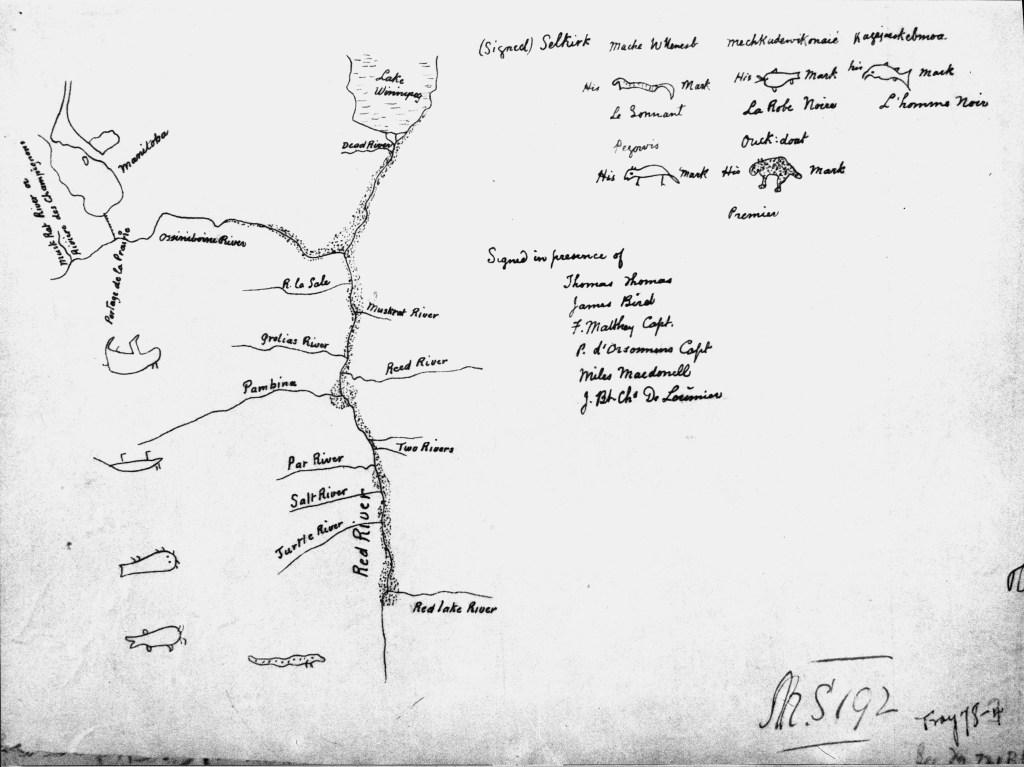
Before the numbered treaties that shaped Western Canada, there was the Selkirk Treaty. Signed on July 18, 1817, it was the first formal written agreement between the British Crown and Indigenous nations in what is now Manitoba. To understand why this treaty happened, one must understand the “Fur Trade Wars” that nearly destroyed the Red River Settlement.¹
The Climate of Conflict: Why a Treaty?
In the years leading up to 1817, the Red River Valley was a literal battleground. The Hudson’s Bay Company (HBC) and the North West Company (NWC) were locked in a violent struggle for control of the fur trade. This reached a breaking point in 1816 at the Battle of Seven Oaks, where Governor Robert Semple and twenty settlers were killed.²
When Thomas Douglas, the 5th Earl of Selkirk, arrived in 1817, his mission was to restore order and provide legal security for his struggling colony. He knew that for the settlers to stay, he needed a formal land agreement with the local Indigenous leaders that would be recognized by British law.³
The Signatories and Witnesses
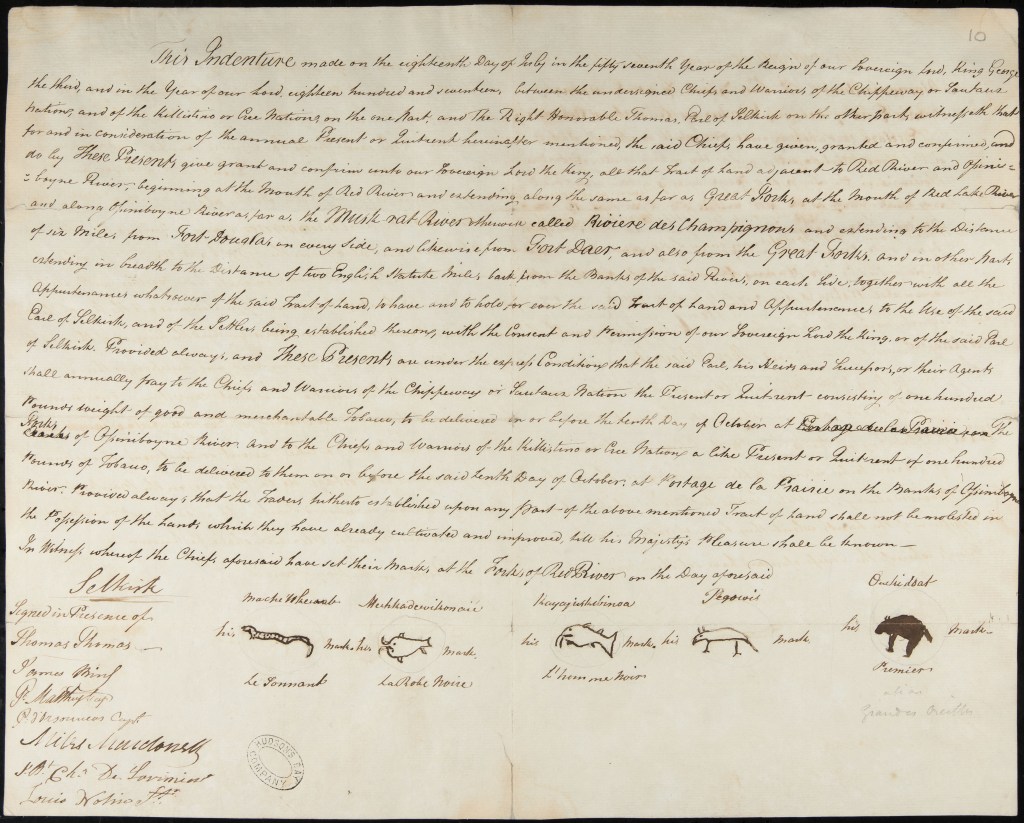
The treaty was an indenture between the Earl of Selkirk and five prominent Chiefs of the Cree and Saulteaux (Ojibwe) nations.
The Five Chiefs:
- Moche W. Keocab (Le Sonnant)
- Mechkadewikonaie (La Robe Noire)
- Kayajieskebinoa (L’Homme Noir)
- Peguis
- Ouckidoat (Le Premier)⁴
The Official Witnesses:
Because of the gravity of the agreement, it was witnessed by the highest-ranking officials in the region at the time. This included:
- James Curtis Bird: Acting Governor of Rupert’s Land.
- Thomas Thomas: Former Governor of the Northern Department.
- Miles Macdonell: Former Governor of Assiniboia.
- Frederick Matthey: A captain in the De Meuron Regiment.⁵
What Was Accomplished?
The treaty granted a strip of land along the Red and Assiniboine Rivers to King George III for the use of the Selkirk Settlement. The boundaries were famously defined by the “Two-Mile Limit”—land extending as far from the riverbanks as a person could see under the belly of a horse.⁶ In exchange, the Chiefs were to receive an annual “quit-rent” or present of 100 pounds of tobacco per nation.⁷
Legacy: From Selkirk to Treaty 1
While the Selkirk Treaty provided the legal basis for the early settlement and the massive land grants given to men like James Curtis Bird, it was eventually seen as insufficient by the Canadian government.
In 1871, following the formation of the province of Manitoba, the Selkirk Treaty was superseded by Treaty No. 1. This new treaty addressed much larger territories and reflected the shifting power dynamics of a new Canadian era. However, the 1817 agreement remains the foundational moment when the “Peace of the Red River” was first put to paper.⁸
Endnotes
- “The Selkirk Treaty,” The Manitoba Museum, manitobamuseum.ca.
- “Battle of Seven Oaks,” The Canadian Encyclopedia, www.thecanadianencyclopedia.ca.
- J.M. Bumsted, The Red River Settlement: Its Rise and Progress (Winnipeg: Watson & Dwyer, 1999).
- “Document – Lord Selkirk’s Treaty with the Indians, July 18, 1817,” Manitoba Historical Society, www.mhs.mb.ca.
- “Selkirk Treaty Witnesses,” Red River North Heritage, redrivernorthheritage.com.
- “The Two-Mile Limit,” Manitoba Land Initiative, mli2.gov.mb.ca.
- Alexander Morris, The Treaties of Canada with the Indians of Manitoba and the North-West Territories (Toronto: Willing & Williamson, 1880).
- “Treaty 1,” The Canadian Encyclopedia, www.thecanadianencyclopedia.ca.
 tilixam
Leave a comment